
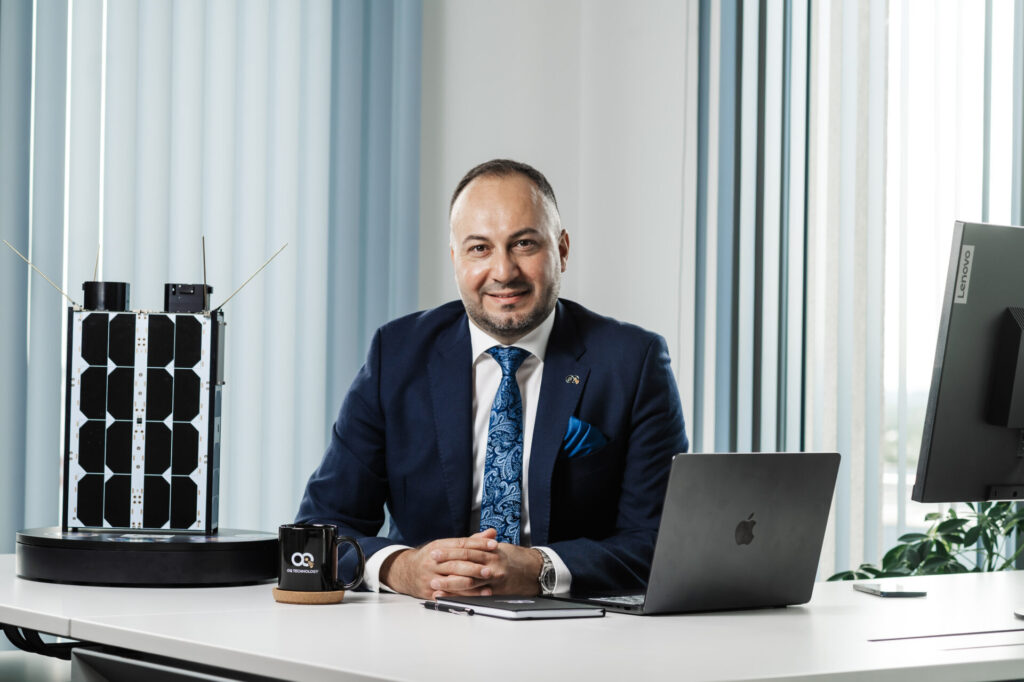
Omar Qaise, Founder and CEO of OQ Technology
Credit: OQ Technology
Please introduce yourself to our AMCHAM audience so they know your origin and family background
My name is Omar Qaise, Founder and CEO of OQ Technology.
Space and technology have fascinated me since childhood. I was captivated by the idea of making the unthinkable possible, sending rockets into space, connecting people across continents, and exploring the unknown. That early curiosity shaped my career path.
I started my professional journey working in satellite communications with major aerospace organizations, including the European Space Agency. Those early experiences exposed me to both the technical and commercial dimensions of the space industry.
Please explain why you came to Luxembourg and your first impression of this country and work environment
Before founding my company, I worked at SES, where I was responsible for Satcom sales and business development, particularly in M2M and oil & gas markets across the Middle East and Africa. I worked also at the European Space Agency, OHB Systems, the German Aerospace Centre and EUMETSAT.
Those early experiences exposed me to both the technical and commercial dimensions of the space industry. Luxembourg stood out as a country with a strong satellite heritage and an ambitious NewSpace vision. My first impression was that it is a small but extremely dynamic country, with direct access to decision-makers and a very international business culture. The ecosystem is efficient, collaborative, and forward-looking, which is essential for a deep-tech space startup.
After working in the private sector, what motivated you to become an entrepreneur and set up your own company
While working in the industry, I realized there was a massive connectivity gap on Earth, especially for machines and IoT devices in remote locations. Billions of devices operate outside reliable cellular coverage.
I wanted to combine my love of space with a very practical mission: connecting the unconnected. That’s why I founded OQ Technology, to use satellite technology to provide standardized 5G NTN IoT and D2D (direct-to-device) connectivity globally.
What has been your experience, what challenges have you faced setting up your company
Building a space company is not for the faint-hearted. There are technical, financial, and regulatory challenges at every stage.
We had to delay one of our early launches three times. We pivoted our business model multiple times before finding the right product-market fit. But resilience is essential in this industry. You must accept that setbacks are part of innovation, especially in space.
Please explain what your company does and its future challenges
OQ Technology is a global leader in 5G NTN and D2D satellite connectivity. We operate a Low Earth Orbit constellation that connects IoT devices directly via satellite.
We are currently expanding our constellation and launching a hybrid 5G service that allows devices to switch seamlessly between terrestrial and satellite networks using a single SIM.
Future challenges include spectrum congestion, space debris management, scaling globally, and ensuring sustainable orbital operations.
How helpful have Lux innovation and the rest of the Lux government been during the process of establishing and growing your company
Luxembourg’s space strategy has created a supportive environment for NewSpace companies. The government’s proactive vision for space commercialization has been instrumental in positioning companies like ours at the forefront of satellite innovation.
The ecosystem encourages entrepreneurship, collaboration, and international partnerships, which are essential in such a global industry.
If you could, what advice would you give to a younger version of yourself just starting this journey
If I could go back, I would tell myself: stay curious and never lose your sense of wonder about space and technology. Be resilient, setbacks, delays, and rejections are part of building something meaningful. Hold firmly to your vision but stay adaptable as markets and technology evolve. And most importantly, building a strong team, space is never a solo journey.
How has your company developed over the years, and what major challenges have you overcome
One of the most memorable milestones was when our first commercial satellite went operational and started sending data from oil fields in the Middle East. That proved that 5G IoT connectivity over satellite works, even in the most remote locations.
It was not just a technological success, but validation that our vision could scale globally.
What failures have you had, and what have you learned from them
We experienced launch delays and had to redesign certain technical elements. We also refined our business model multiple times.
The lesson is clear: failure is feedback. In space, you must combine patience with persistence. Each setback strengthens your system, your team, and your strategy.
What challenges are you presently facing as you continue to grow as a company
Three key industry challenges concern me:
• Space debris and orbital sustainability
• Spectrum congestion and global coordination
• Ensuring equitable access to space-based services
As industry commercializes rapidly, responsible growth is essential.
What would you like the government to do to become more supportive of companies like yours
Governments can help by:
• Creating inclusive economic models that allow smaller companies and developing regions to access space services
• Invest in scale-ups directly or create programs to create champions.
Space should benefit everyone, not just a few large players
In what ways are you optimistic or pessimistic about the future success of your company
I am very optimistic.
The commercialization of space is accelerating. Direct-to-device connectivity is transforming telecommunications. Startups are driving innovation at unprecedented speed.
We are entering an era where space is no longer government-only, it is entrepreneurial, global, and impact-driven. And that gives me confidence that OQ Technology will continue to play a meaningful role in shaping global connectivity.
Disclaimer: The views and opinions expressed are those of the authors and do not necessarily reflect an official policy or position of AmCham.lu. Any content provided by our interviewees are of their opinion, and are presented in their own words.