
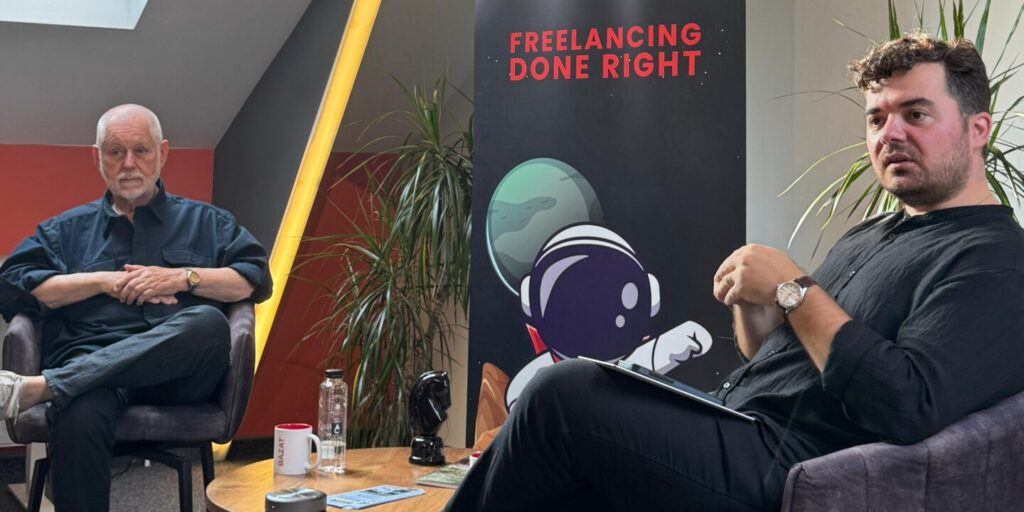
Paul Schonenberg, Chairman and CEO of AmCham, interviews George Retegan, founder of Base7 ecosystem of self employed IT professionals in Romania
Company website: https://at.base7.tech
LinkedIN George Retegan: https://www.linkedin.com/in/george-retegan/?originalSubdomain=ro
On the occasion of Paul’s visit to Romania in August 2025, Paul and George met at the offices of Base7 in Cluj-Napoca (Transylvania) for a discussion around the current international business context and opportunities for growth. The members of Base7 had the opportunity to find out more about the Luxembourgish context and ask specific questions on how best to tackle the European and international market.
Following this event, Paul interviewed George on the business model of Base7, inviting him to describe it and then share how it was all built.
George, I believe it would be of interest for AMCHAM members to know more about the business model of Base7.
The Base7 ecosystem has at its center the Base7 Community, professionals who have registered as members of Base7. The Community is connected to the four focus areas of Base7: LEARNING, TALENT – PROJECT MATCHING, SOLUTION DELIVERY and in the very near future, the LAUNCHPAD.
Historically, the community was first formed around a LEARNING initiative, IT professionals who approached Base7 for accompanying them in their self-employed journey.
We then developed the possibility of these self-employed professionals being matched (TALENT – PROJECT MATCHING) with requests coming from clients on a specialised team augmentation revenue model (Base7 professionals complete the expertise the client already holds). This initiative connects back to Learning through the fact that Base7 oversees the professional development of the professional and a satisfactory working relationship with the client. We find the best project for each professional, while assuring client expectations are met.
The SOLUTION DELIVERY initiative encompasses both the delivery of IT services, and the delivery of consulting, architecture (solution, function, technical), product and project management, support, design services. Finally, LAUNCHPAD functions as a base for the creation of new companies and the delivery of new products – as spin-offs or joint ventures.
Let me give you an example. If a professional joins Base7 as a student within our LEARNING initiative, after some time, he accesses the pipeline for TALENT – PROJECT MATCHING and SOLUTION DELIVERY. The LEARNING path of the professional (in particular the program Freelancing Done Right) allows for valuable insights into the competences, talents and wishes of that particular professional. Moreover, his/her feedback, as well as the feedback from the beneficiary, the partner, supports an optimal trustworthy working relationship under the motto “The right talent in the right place, with no unnecessary overhead and no bench”. We know exactly who is the right professional for the project, or the ideal project for the professional.
This type of community-based model affords innovative solutions and adaptive problem-solving and it is fuelled by the mentoring process which accompanies the Base7 professional throughput his becoming. We therefore refer to it as “ecosystem”. We invite you all to reach to Base7 for our TALENT – PROJECT MATCHING capabilities, we assure you we will find the right person for your specific needs, with not only a matching at the technical skills level, but more importantly, a matching at the values and priorities level. Together with our community we provide a solid trustworthyness level that allows projects to be delivered end-to-end.
Base7 MISSION STATEMENT: Enable individual professionals, teams and tech companies to advance the delivery of high-quality personalised solutions for their customers
Base7 VISION STATEMENT: To deliver and maintain reliable IT integration solutions in minimum time using an international united community
Base7 IMPACT STATEMENT: Make sure that every professional can build and leverage software technology globally, using agile business models and being able to work from anywhere.
Base7, what’s in a name?
Base7 Tech (https://at.base7.tech) is one of Eastern Europe’s leading tech communities, combining self-employed professionals excellence, agile delivery, and startup innovation under one roof. It powers companies across Europe, from scale-ups to enterprise teams, with elite freelance IT managed teams, full-cycle product development, and custom mentorship programs. Our community includes vetted professionals with experience at global tech leaders such as Google, Microsoft, Airbus, and Twitter.
Since launch, Base7 has delivered over 30 high-impact projects in industries like logistics, fintech, aviation, telecom, banking and e-commerce, achieving a 100% contract extension rate with key clients. We are recognized for our community-driven delivery model, business-aligned engineering, and hybrid collaboration formats that scale with client needs.
The name came from one of our earlier co-founders, Andrei. “base”, in translation from Romanian, “baza” is a place where you belong, where you come back, where you plan, where you do your strategy, where you bring all your ressources together, where you recharge and then you go out in the market and you apply what you’ve learned. It’s at the same time a learning space and a taking action space. All of that in a community of practice, with likeminded professionals.
Our wish is to be perceived as a place to go, as a place to be, as a place to grow, not as a service.
This year, we will celebrate 5 years of existence.
What does Base7 do?
For me it’s a place where we gather , as a community of self-employed professionals, and we build. Firstly, we build our independence and our autonomy, we build ourselves as self-employed professionals. And secondly, we build valuable economical models which make sense, so we can be still relevant on the market in the long run. I think we can say we focus our energy in order to have a larger impact than we would have on our own.
Where does the model come from? Is it something you’ve seen around you? Is it something you’ve seen outside the country? Or is it more of a need that was identified and then you started building on that?
It’s a mix between a need and a desire. And the need would be to not be forced to leave the country in order to have a European status in terms of financials and also knowledge and culture. So, that would mean to be part of international teams that can provide you with the financials and also with their organizational culture that shape you as a professional and, of course, as a person.
Today, as IT professionals, we do face really transformative years or period, better say. So, the model changes. We are no longer required to be service providers. So, it’s a dying business so to speak. We do need to acquire new skills and new knowledge in order to be able to become relevant for the new demand, both in terms of solutions and products. So, we have an opportunity that will, in my view, determine the relevance of the industry sector in Romania.
The opportunity is to use this transformation or transformational period and develop a community which acts like a base and provides the structure and the blueprints for the independant members to act as one.
This would allow to develop sustainable local businesses which are however responding to an international new kind of demand that’s generated by AI mostly and also shaped by the recessions which we see in a variety of economies.
It’s also a mindset challenge for my generation of professionals born and raised in Romania. Therefore I think being more independent and more autonomous, acting more entrepreneurial, while actively being part of a community, is a mindset which supports solution and product delivery at the international level. You can look at this almost like a family business model. We go about our business independently, while constantly touching base with the family/core, the community of Base7. That’s how ideas, projects and new collaborations are born.
What is the biggest challenge? Do you think building this type of model of interaction of business in a different country would have given different results? Or do you think there is something which is specific to this Romanian environment?
The most important asset which we can, let’s say, impact in my view, with our model, is the time element. How long it takes to trust a stranger. Sign a contract. Do the deal. Make it work.
In order for this specific model to work, it requires hundreds of professionals to share the same challenges, share the same objectives, more or less, and accept a common set of values while being a member of the community. So with this model, what is done in 3 months in another part of the world, maybe we can do it in 3 weeks, within a community like Base7. So building a community is trusting the other, tell him/her your plans, your challenges, be happy for his/her success and also being coachable.
Tell us more about that, the mentoring services offered to your members.
The mentors in our community, they really help you. But if you think you already know everything, it’s really hard for them to say you don’t. Maybe you do know everything, but maybe you only need a different angle. And the mentor will provide you with that different angle.
Tell us a little bit about yourself, how have you grown into who you are today.
I think it started when I signed the first contract with a real customer. And that was back in 2014.
Before that, I had a two months employee experience. Because the university had this mandatory internship program. One of the exams was being part of a real company. So you get some credits from there. I had to do it, I was an intern. It did not respond, however, to my expectations. So maybe I was too high on my expectations when I joined the company.
Afterwards, I was convinced I can do it on my own. I just needed to try. And I did exactly that. I’ve met others who were already working on their own, like Razvan and Radu. They were especially good at what they were doing. And I was attracted to that. I decided immediately that I really wanted to be really fast, really good at something. And then being able to manage my own portfolio of clients. So I get to decide what I will be good at. I get to decide for whom I will invest my time and skills.
So that’s how I got to have my first client in 2014, a local tourism company. I was 22. That was the initial decision, which I think is important. Not to find a job.
And it worked out…With support from mentors.
I discovered in this specific technology that there is a new language. Back then it was launched in 2014. It was called Swift. I needed to find a way to learn it really, really fast. So I met Andrei, who later on was the co-founder of Base7. He was already good at Swift. Can you make time to teach me how to code this new tool? And he said yes. I had, I think, two meetings with Andrei per week. And I was able to send my first line of code in production in under four months, like three and something. It was really good.
Then I started coding for real, for clients, being part of teams, international teams, local teams, you name it. I think last year I’ve counted 62 projects in the portfolio so far.
And in the meantime, Andrei went to Google. He needed this international experience on his own. And being part of a large company, he was really curious about it. And I think he was there for two or three years, something like that. In the meantime, I’ve developed a portfolio and also a team. We delivered solutions together. So we had a studio. It was built of nine professionals. So we had the management, we have the design, we have the back and the front and the mobile database, you name it.
Then we’ve met again with Andrei after he came back to Romania. Together we were delivering IT solutions and trying to build a business. We were discussing how can we do it better? How can we do it bigger? How can you scale it? What can we do to make it better, faster, cheaper, you name it? How to improve?
And the first thing we did, I think it was an important decision, not try to solve this problem, but just try to see how many people in Romania, at least, really think this is a problem. And the problem was that if in order for you to have higher quality of professional life, you need to get out of Romania. So you need to emigrate. Let’s see how many tech professionals in Romania today really consider emigrating for these reasons. How many of 220.000 IT professionals (now there are 250,000) consider this a problem? For how many of them this is an important topic? So how can you answer this question? Ask them. So we build a landing page. We said, OK, we’re building a community of people who are interested in developing something more than a job.
And they also know tech, right? So our initial target was 50 clients. Well, the idea is that we can teach them what we’ve already built, right? So we’ve been freelancers, then getting up to the studio out of nine freelancers. So that’s something we can mentor you about, we thought.
So the target was 50 clients. And it was like, if it’s important to them, then we should invest. If it’s not important to them, then we should not take the risk. That simple, right? We had 62 clients in the first year.
And after we validated that the problem is real and the market is there, then we start building a model of delivery service, like mentoring service, a learning service. And afterwards, building more complex business model on top of what we actually created. It was not a question of, will this work or not? No, we were extremely positive about the outcome. Maybe a little bit naive, but it worked.
And then we tackled the trust issue. So we went on TV and join a show and explain what we do so we can get some real feedback from real business people who validated us in front of everyone. And they were agreeing that this is necessary and this is valuable and we are the right team to do it. And afterwards, we had enough self-confidence to go and contact the companies with what we’ve already built. So the business started.
Maybe the last question before we finish is, can you think of a moment in time where something happened, somebody came to you, there was some sort of opening of ideas that stayed with you and that really constitutes your base. The go-to moment that supports you into moving further, keep doing this, developing it, meeting new people, basically to continue making it happen.
There are many persons who contributed decisively. And I think the first one is our current shareholder, Alexandru Tulai, who was present from day minus one up to today. And he did brought a lot of resources in order for these projects to become a seed and a startup and a company growing. We also have the best people in our teams today. So in terms of people and colleagues, and I think also organizational culture, that’s something which I rely on every time. Because I know maybe it’s hard, maybe it’s even frustrating at some point. Maybe you lose a contract, maybe something unexpected happens and you don’t agree with that. But when you see how the team reacts and when you see how other people care, it’s enough, at least for me. So if you want to be my partner, it’s easy. You need to care and you need to act as an adult when hard times come. I was lucky enough to have this kind of partners.
Because you mentioned values and I didn’t follow up on that, maybe the last question is what would you say are the values of what you’ve managed to build?
We’ll start by having integrity and performance as the first two pillars. And afterwards, we do have agility and respect as a second pillar. It’s really important, integrity, because we are working independently. We have international clients. We don’t have this human connection as much as we would love to. So we do need to rely on each other. So you need to say what you think on time and do what you say on time. That’s how we see integrity. In terms of performance, you know, people come to Base7 because they want more than a job, mostly. So these are some of the best people in companies that join our community. So if they would find the same offering in our community as they had in the company they are living, actually, we would not be relevant for them. So we do need high stake projects and opportunities. We need to talk about performance. We need to be on top because this is what is expected from us.
How can you summarize Base7 in figures?
5 years of experience on the international market
+4000 members
over 100 online events
over 20 physical events
3 organized workations®
over 20 business partners
+10 IT solutions generated in the community
+5 companies (start-ups, agencies, studios) formed in the community
over 500 IT engineers ready for new projects
Disclaimer : The views and opinions expressed are those of the authors and do not necessarily reflect an official policy or position of AmCham.lu. Any content provided by our interviewees are of their opinion, and are presented in their own words.