
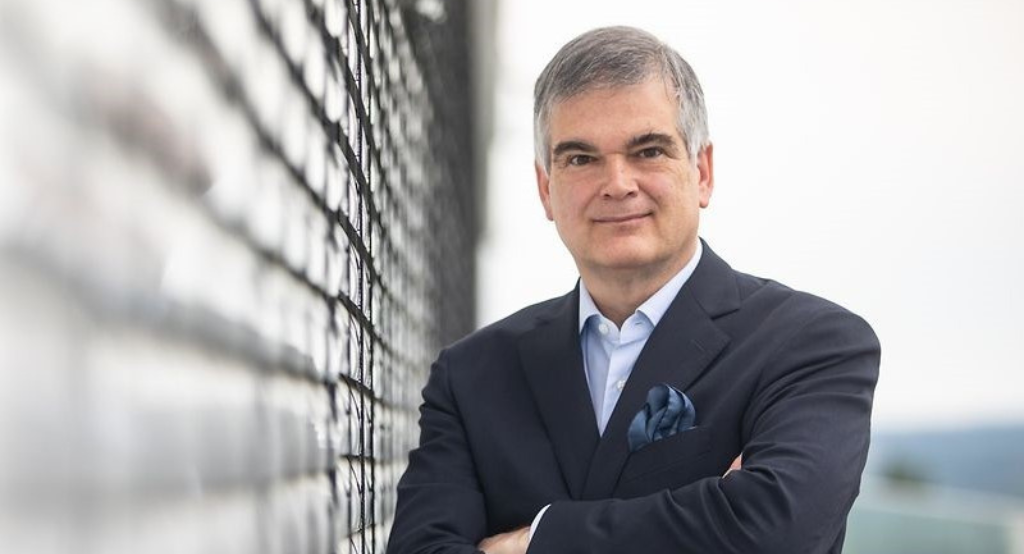
Claude Marx, General Director of the Commission de Surveillance du Secteur Financier (CSSF)
Introduction to the interview with Claude Marx
The Finance Committee of Amcham had the pleasure to facilitate an interview with Claude Marx, the General Director of the Commission de Surveillance du Secteur Financier (CSSF).
In this interview, the General Director will talk about key industry topics, ranging from the role of AI to Financial Education and Literacy.
He also covers key points outlined in the CSSF’s annual report which is publicly available on their website and highlights the regulators activities and focus areas within the financial services industry.
AML : Following the FATF review, what is the current supervisory focus in AML/CFT?
After a positive overall FATF review, the supervisory focus is now shifting particularly towards terrorist financing. AML and Counter Terrorist Financing (CFT) is continuing to evolve as money laundering and terrorist financing methods grow more sophisticated across borders.
Institutions must ensure robust transaction monitoring, beneficial ownership transparency and strengthen cross-border cooperation.
AI: What is the CSSF’s expectation as to how AI will impact the Luxembourg financial center?
It is of course a very topical matter. It is essential to note the importance of AI and data science expertise at senior management and board level positions. Traditional board profiles may lack the skills to lead AI-driven strategies. To avoid superficial transformation, companies must embed internal AI/data science expertise at the decision-making level. External consultants can help with the implementation of AI driven strategies, however internal expertise is key for a sustainable long-term strategy relating to this topic.
Financial education: Do you think that Luxembourg is doing enough in this respect? What else should be done in your view?
I am a big advocate for Financial Education in Luxembourg. There is an ongoing initiative to support financial literacy in schools which is key.
Savings ultimately should contribute to stronger long-term capital markets. Currently, in the EU, 30-40% of financial assets from household savings are in the form of cash and deposits which is significantly higher than our US counterparts. Redirecting part of these savings into capital markets could be a transformational shift for the European economy and could help potentially unlock trillions of euros.
Green Finance: Will the current macroeconomic environment have an impact on future policy making in the EU?
If we look at the current SFDR framework, It can be seen as too complex and fragmented, making it hard for stakeholders to navigate. We need to look at simplifying Green Finance legislation and encourage EU-wide harmonisation which is strongly supported by Luxembourg.
A good example to share is LuxFLAG (Luxembourg Finance Labelling Agency). It is an independent, non-profit organization based in Luxembourg that provides labels for financial products to promote transparency and trust in sustainable finance.
Single European regulator: The “Draghi Report” recommends transforming ESMA into a single regulator for all EU securities markets. How likely is this to happen and what would be the consequences for Luxembourg?
I do not believe the creation of a single EU-level fund supervisor will be beneficial for Luxembourg and its financial ecosystem. Investment products differ too much across member states and therefore having a central supervision is, as a result, unrealistic. Instead, there is an argument for aligning reporting standards to reduce duplication, while keeping oversight at a national level.
More generically, there is a need for regulatory simplification, taking into account speed and burden reduction.
Bank account opening: One of the biggest challenges for the competitiveness of Luxembourg is currently the difficulty to open bank accounts. What can be done in your view to ease this process?
It is certainly a challenge and we must collectively work towards streamlining this process to remain competitive. There have been examples in the market, particularly in the retail space, with the closure of bank accounts and this can have a knock-on impact to the industry. Fortunately, there are a number of initiatives underway, an example being the collaboration with industry bodies such as ABBL, where a list has been put together to identify bank account providers for specific segments within Luxembourg’s financial ecosystem.
Are there any other areas of opportunities or challenges you would like to mention before we close the interview?
To mention a few, one area of focus in the current environment is Cybersecurity. We have seen non-financial sectors heavily impacted. While the banking sector has not been as much affected, cyberattack threats require banks to invest in protections that strengthen vigilance and resilience.
Another area related to Private Assets is concerning the growing importance for transparent valuations within the private markets (Private Equity, Private Debt, Real Estate, Infrastructure) Supervisors will intensify the scrutiny of methodologies, governance and resilience, particularly during economic downturns.
Lastly, regarding the current market landscape, we see a revitalisation in the securitisation space which is key to funding SMEs and infrastructure. Luxembourg is well positioned given its established framework and expertise.