
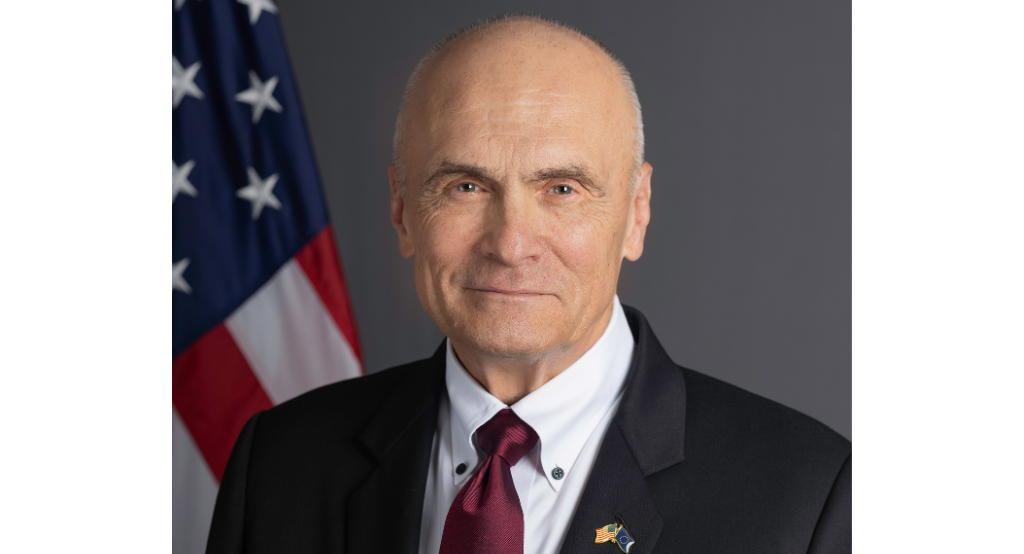
Remarks by Andrew Puzder
2026 AmCham EU Transatlantic Dinner
March 17, 2026
Thank you, Liam, for that very generous introduction.
I want to thank Malte [Lohan] and Liam [Benham] as well as the Board and team here at AmCham EU for organizing this wonderful event.
I’m encouraged to see not only distinguished business community leaders here tonight but also distinguished Members of the European Parliament, distinguished Commission officials and distinguished fellow ambassadors. Its an impressive gathering.
As you all know, my government job as the US Ambassador to the EU is to advance President Trump’s agenda. President Trump realized early on that US foreign policy needed a recalibration. Many of our institutions and policy assumptions were built for a world that no longer existed, requiring us to re-examine those assumptions.
One critical concern was the subordination of our ‘national interest’ to globalist objectives. Whether the US or the EU, the needs of our citizens and our economies, that is, our respective national interests, should be at the core of our economic and foreign policies. Only then can we come to the table and truly reach pragmatic solutions that work for us together.
But let’s be clear, as Secretary Rubio has stated clearly – America First does not mean America alone.
A prominent example of our growing stronger together is last summer’s Joint Statement on Reciprocal, Fair, and Balanced Trade, in which the United States and the EU committed to adjust tariffs on goods and to work together to reduce or eliminate non-tariff trade barriers that unnecessarily burden our transatlantic trade relationship.
That trade relationship is the largest in the history of the world and – as our National Security Statement pointed out – it remains a pillar of the global economy and our mutual economic prosperity.
Our deep commercial ties, industrial cooperation, and shared capacity for innovation and productivity, generate economic growth on both sides of the Atlantic.
I’ve said this many times, but it bears repeating – It is in the best interest of the United States that the EU prospers. We want the EU to remain a valued trade partner, to become an ally capable of defending itself and joining with the United States to address issues in trouble spots across the globe.
But let’s be honest. Over six and a half months have passed since the Joint Statement was released and about 8 months since the meeting at Turnberry. The United States quickly responded, bringing tariffs to historically low most-favored nation rates –on planes and plane parts and on generic pharmaceuticals, among other sectors. To demonstrate our good faith, particularly for our friends in Germany, we brought tariffs on cars down from 27.5 percent to 15 percent.
Nonetheless, EU tariffs on US goods haven’t changed.
We understand that the EU must follow its process. But we’re hopeful that, after 6 and a half months, the time has come – and we’ve respectfully requested that – the EU finalize the deal so we can mutually unlock the potential for positive collaboration – for the betterment of our economies and our joint security.
Personally, I’m optimistic that together we’ll get this done.
Now, I’d like to discuss the EU’s potential for meaningful economic growth apart from, but including, the Trade Agreement.
Over the past seven months, I’ve had the opportunity to meet with many of you and hear diverse perspectives on the actions we can collectively take to grow not only the transatlantic economy generally – but the EU economy specifically.
In those meetings, I’ve heard the frustrations both US and EU businesses have experienced dealing with the EU’s massive, growth hobbling, regulatory state – that seemingly attempts to put bureaucrats in control of virtually every aspect of your businesses and the economy.
Perhaps the most frustrating thing I hear is how these regulatory impediments to growth – which were designed to apply extraterritorially and change the world – have had the unexpected consequence of negatively impacting the EU’s economic prosperity – stifling job creation, investments and competitiveness – while the rest of the world moved on.
I also hear those in the Brussels Bubble invoking “competitiveness” as the solution for the EU’s floundering economy. While the concept of making the EU more competitive – Professor Draghi’s term – is a good one, unfortunately, this focus on competitiveness can encourage efforts to punish economic partners.
That is to make those viewed as economic competitors less competitive – rather than making the EU more competitive. The problem with this approach is that the real culprit is not the EU’s competition –– it’s the EU’s oppressive energy and economic regulations.
You don’t make the EU more competitive by making others less competitive. You only make the EU more competitive by addressing the underlying issues that made the EU less competitive in the first place.
True competitiveness requires Europe to stop treating the success of other free market competitors as a threat – but rather by treating the EU’s own entrepreneurs as assets worth liberating – and companies from free market economies doing business in Europe – as partners for growth – rather than targets for regulation.
In this respect, another EU term of art – “Simplification” – falls short. Respectfully, the EU needs far fewer regulations, not just simpler ones. All economic indicators are calling for – if not screaming for – “deregulation” on a massive scale.
German Chancellor Merz, Belgian Prime Minister De Wever, Italian Prime Minister Meloni and other member state leaders have all called for serious regulatory reform. As Chancellor Merz recently stated, the EU has become “the world champion of regulation. That has to stop.”
In the current environment, meaningful economic growth requires that the EU prioritize market integration, slashing red tape, and embracing flexible rules that reward – rather than punish – risk-taking and innovation.
Plus, a focus on energy abundance for lower prices and resilience. A Shift from precaution to promotion. And an easing of AI and biotech hurdles to unleash startups.
Europe’s talent is world-class, its entrepreneurs are among the most innovative on the planet, but policies have to let them flourish.
The United States wants to see the Transatlantic Trade relationship surge – and lead the status quo in the Second Great Divergence that Artificial Intelligence is creating.
The First Great Divergence was the Industrial Revolution. The economic implications of that Revolution were stark. Countries that “industrialized” prospered economically and those that failed to industrialize floundered. AI will have that kind of economic impact – but on steroids.
Even beyond its economic implications, AI will have enormous national security consequences, shaping who wins future conflicts and whose vision of global order prevails. The intelligence, logistics, and decision-making advantages that powerful AI systems confer will deliver near-term gains in military effectiveness (as recent events have confirmed) and compounding advantages that endure far into the future.
The United States is pursuing a strategy focused on accelerated innovation, infrastructure development, partnerships, technology exports and deregulation – to lay the groundwork for American AI dominance, and to establish a durable global economic order based on Western values – underwriting an AI-driven era of prosperity across partner countries – to win the AI race.
The US Department of Energy’s Genesis Mission is an AI initiative meant to connect our best supercomputers, AI systems, user facilities, and federal scientific datasets – across the American research and innovation environment – to accelerate discovery, strengthen national security, and drive energy innovation.
In just the first half of 2025, AI-related investment alone increased U.S. GDP by an annualized 1.3 percentage points That’s an uncommon surge reminiscent of the Industrial Revolution’s investment boom in the 19th and early 20th centuries.
But what’s even more significant is why it’s happening. The United States didn’t stumble into this moment – we prepared for it. We restored full expensing for capital investment. We cut red tape around data centers, power lines, and chip manufacturing. And we reasserted energy dominance to unlock the fossil fuels and nuclear capacity needed to power the AI economy.
Europe has the talent, companies, and capital to be an important partner, but the moment requires an accelerated embrace of pragmatic policies. The EU needs abundant, affordable energy. Energy is not a sector of the economy; it is the economy.
So, first, to join the AI economy, the EU must embrace “energy abundance and addition” (a phrase President Von der Leyen recently used in her speech at the Nuclear Energy Summit just last week), and reject policies that increase the cost and limit the use of fossil fuels.
This doesn’t mean deserting renewable energy. Rather, build it out as fast as possible – and with domestically manufactured equipment as much as possible. Also build out nuclear power as President Von der Leyen wisely advocated.
But the EU’s ambitious Green Deal and push to reduce carbon and methane emissions have turbo-charged energy costs and created systemic vulnerabilities with minimal global impact. As a result, both European households and businesses face bills that actually do erode “competitiveness.”
EU regulations that attempt to impose reduced carbon or methane emission requirements both here and extraterritorially will not foster economic growth in the EU.
To the contrary, they will limit energy supplies and increase energy costs – in Europe. Countries like China and the US are not only in an AI race, they are in an energy race that may determine who wins the AI race. They’re not going to slow down because of EU regulations.
Second, the EU needs to build. It needs data centers and access to the U.S. AI hardware stack. The US companies with the resources to build-out multi-billion-dollar AI infrastructure in Europe already operate in Europe, employing thousands of Europeans. They’re willing to invest and grow, bringing Europe into the AI economy as a full partner if the EU only lets them.
Europe can play in this architecture—if it shows up as a genuine partner. The State Department’s Pax Silica initiative is building exactly the kind of allied network the AI race requires, knitting together energy, critical minerals, semiconductor manufacturing, and computing capacity across trusted nations. We believe the EU’s talent, capital, and industrial base belong in that network, and we’re hopeful that the EU is going to join.
But here’s the thing, this isn’t just about market access or profitability. It’s about ensuring that transatlantic ties remain strong and that we’re ready to face whatever challenges come our way.
Trade isn’t just the buying and selling of products; it’s our lifeline. And to keep those lifelines open, we need policies that encourage cooperation, not fragmentation. We need an environment where U.S. and European companies can work together seamlessly, leveraging each other’s strengths to meet the demands of a rapidly evolving world.
The US/EU Trade Agreement, Pax Silica and the Critical Minerals deal – all of which we are currently working on – together with the EU – can lay the foundation for a mutually prosperous energy and AI driven future.
Together, we can strengthen our partnership, foster innovation, and ensure that we’re all better off, on both sides of the Atlantic.
Under President Trump’s leadership, America is building the foundations for a century of innovation—powered by energy, driven by enterprise, and grounded in freedom. We invite our transatlantic partners to join us. And we sincerely hope you will. May God Bless the United States of America and may God Bless our European allies. Thank you
Before I end, I want to acknowledge the next speaker my, friend Ukrainian Ambassador Chentsov.
Ambassador – President Trump has made clear, the death and destruction in Ukraine must stop, and I know we all pray – in support of the Ukrainian people – that it does. I’m looking forward to hearing your remarks.